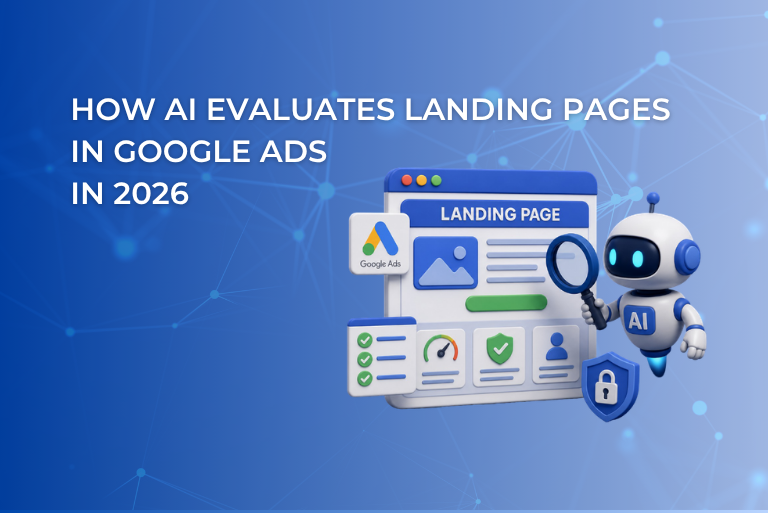
Google Ads remains one of the most popular traffic sources for affiliate marketing. However, as AI models continue to evolve, ad moderation has become significantly stricter.
Today, Google evaluates not only ad creatives and keywords but also landing page quality, user behavior after the click, page structure, and even the overall trustworthiness of the advertising account.
In this article, we’ll cover:
- how Google’s AI systems evaluate landing pages in 2026;
- which signals most commonly lead to ad disapprovals;
- why “gray-hat” tactics are becoming less effective;
- how to prepare your landing pages for modern moderation algorithms.
Why Google has strengthened landing page reviews
Over the past two years, Google has significantly increased its focus on the quality of ads and landing pages. The main reason is the rapid growth of fraudulent ads, AI-generated content, and large-scale spam.
In 2026, Google relies heavily on Gemini AI and behavioral analysis. Its algorithms evaluate not only individual landing pages but the entire advertising ecosystem, including the account, creatives, domains, campaign history, and traffic quality.
According to the official Google Ads Safety Report, Google blocked or removed more than 8.3 billion ads and suspended 24.9 million advertiser accounts in 2025 alone. Most policy violations were detected automatically before the ads were ever shown to users.
As a result, moderation has become:
- faster;
- more comprehensive;
- less dependent on manual review;
- increasingly driven by AI-based evaluation of user behavior and content quality.
How Google evaluates landing pages
Let’s break it down based on how it works in practice rather than how it’s described in official documentation.

Page content
Google’s systems no longer rely on detecting prohibited keywords alone. They understand the context and intent of the content. Aggressive calls to action, implied promises, manipulative messaging, and misleading elements can all be identified at a contextual level. A landing page may appear compliant to a human reviewer while still being flagged as high-risk by Google’s AI.
User behavior
This has become one of the most important ranking signals in recent years.
Google analyzes metrics such as bounce rate, time on page, return-to-search behavior, and overall engagement. If users consistently leave a landing page within a few seconds, it becomes a negative quality signal that influences how the page is evaluated going forward.
Template detection
AI has become highly effective at identifying common affiliate templates, cloned landing pages, and low-quality advertorials—even when they look visually different.
Google analyzes DOM structure, JavaScript patterns, and behavioral similarities. Two pages may have different designs while still being recognized as part of the same template network.
Cloaking detection
Cloaking detection hasn’t disappeared—it has simply become more sophisticated.
Google compares different user agents, mobile and desktop rendering, repeat visits from different IP addresses, and JavaScript execution. Inconsistent content delivery and suspicious redirect behavior are now detected much faster than before.
Account trust
Even a high-quality landing page cannot fully compensate for a poor account history.
Google considers factors such as account age, campaign history, billing stability, previous policy violations, and user complaints. Together, these contribute to what is effectively a trust score—and it works in both directions.
Which signals most commonly lead to disapprovals

Today, Google’s systems pay particular attention to:
Misleading claims and hidden promises
(Exaggerated or inaccurate claims that may deceive users.)
Fake countdown timers
(Artificial urgency created through false promotions or fabricated time limits.)
Hidden redirects and auto-download scripts
(Automatically redirecting users or initiating downloads without their explicit action.)
Fake system notifications
(Imitating browser, antivirus, or operating system warnings to manipulate users.)
Overloaded AI-generated content
(Large amounts of AI-generated text that provide little originality or value.)
Lack of clear information about the product or company
(Insufficient transparency, such as missing business details, contact information, or product descriptions.)
Aggressive advertorial tactics
(Manipulative advertorial content disguised as objective editorial material.)
Google also continues to strengthen enforcement against scam advertising and fraudulent offers, particularly in finance and nutra verticals.
Why gray-hat methods are becoming less effective
White pages, preload scripts, domain rotation, and rapid landing page replacement once provided enough time to bypass moderation. That is no longer the case.
Today’s systems evaluate much more than the initial approval process. Google analyzes behavioral correlations, cross-account data, real-time risk scores, and machine learning-based anomaly detection.
As a result, bypassing moderation has become significantly more expensive, more complex, and much more likely to result in account suspension.
How to prepare landing pages for Google’s modern algorithms

Ultimately, it comes down to one principle: your landing page should be transparent, fast, and user-friendly. While this may sound obvious, these are exactly the qualities Google’s systems reward today.
In 2026, it’s especially important to have:
- fast loading speed, particularly on mobile devices;
- strong consistency between the ad and the landing page;
- a logical page structure without unnecessary distractions;
- original content instead of recycled templates;
- a trustworthy domain with a solid history;
- no misleading elements, even minor ones;
- stable page behavior without sudden structural changes.
One more factor that is often underestimated is continuous performance monitoring. Conversion rate, bounce rate, time on page, suspicious user agents, and unusual traffic spikes should be monitored regularly—not only when performance starts to decline.
Why tracking is more important than ever
As Google increasingly relies on traffic quality and behavioral signals, affiliates need greater visibility into what happens after a campaign goes live.
Google Ads reporting alone is often not enough, especially when you need to quickly identify anomalies, evaluate traffic quality, or compare the performance of different campaign setups.
Tracking platforms provide deeper campaign insights by helping marketers monitor conversions, detect suspicious activity, filter low-quality traffic, and optimize campaigns more effectively.
With AdsBridge, teams can identify problem areas faster, test landing pages more efficiently, and make optimization decisions based on detailed performance data.
Start using AdsBridge today to test your campaigns with deeper analytics and greater control over your traffic.