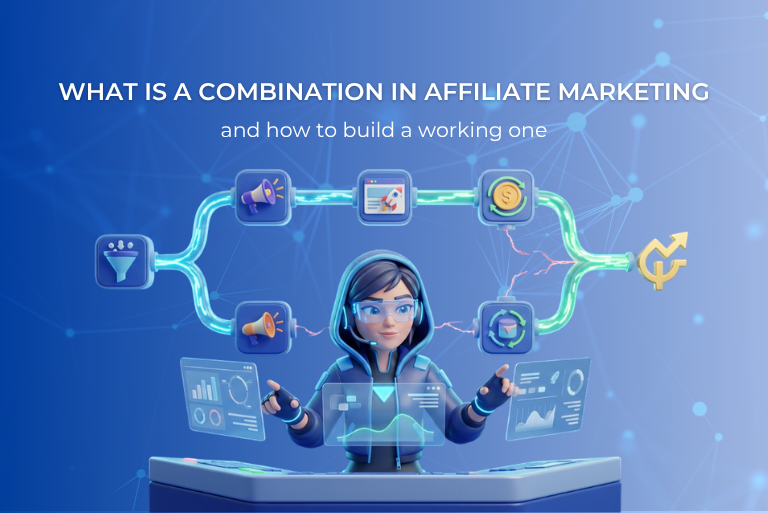
In affiliate marketing, there can be endless debates about the best traffic sources, offers, and approaches. But profit is made not by individual elements, but by combinations.
Even a strong offer won’t save a bad creative. And high-quality traffic won’t help if the landing page converts poorly or tracking is set up incorrectly.
In this article, we will cover:
- what a combination in affiliate marketing is;
- what elements it consists of;
- how to find working hypotheses;
- how to test combinations without wasting budget;
- why scaling without a tracker is almost impossible.
What is a combination in affiliate marketing

A combination is a set of elements that leads a user to a conversion and generates profit for the affiliate.
Simply put:
traffic source → creative → prelanding page → landing page → offer → conversion
If the entire chain works profitably, the combination is considered successful.
But it’s important to understand: the same offer can perform extremely well in TikTok and completely fail in Facebook. The same creative can deliver +80% ROI on Android and lose money on iOS. In affiliate marketing, there are no universal solutions – only testing and analytics.
What a combination consists of

Traffic source
The starting point of any combination is traffic.
Popular sources:
- Facebook Ads;
- TikTok Ads;
- Google Ads;
- ad networks;
- native advertising;
- SEO;
- influencer traffic;
- in-app networks.
The choice of traffic source affects literally everything:
- creative formats;
- audience;
- preheating approach;
- lead cost;
- traffic volume;
- moderation requirements.
For example:
- TikTok prefers native and dynamic content;
- Facebook requires a strong angle;
- in ad networks, for example push traffic often works through aggressive pre-landers;
- Google performs best with existing demand.
Offer
An offer is a product or action that is paid for.
This can be:
- registration;
- deposit;
- purchase;
- app install;
- subscription;
- application;
- trial.
Beginners often choose offers based on payout size. This is a mistake.
You should look at:
- EPC;
- CR;
- approval rate;
- hold;
- geo;
- traffic restrictions;
- advertiser stability.
A high payout means nothing if the offer converts poorly or has a low approval rate.
Creative
The creative is the main click trigger.
It determines:
- whether the ad is noticed;
- whether the user is interested;
- how much the click costs;
- CTR performance.
Today, combinations live shorter than before, so testing speed is critical. One successful creative can pay for dozens of failed tests.
What is usually tested:
- images;
- videos;
- hooks;
- CTAs;
- audience pain points;
- different angles;
- UGC formats;
- AI-generated creatives.
The main mistake is falling in love with one creative and not refreshing approaches.
Pre-landing page
A pre-landing page is used to warm up the user before the offer.
Especially relevant for:
- nutra;
- crypto;
- gambling;
- finance;
- sweepstakes.
The purpose of a pre-lander:
- increase trust;
- filter non-target users;
- prepare the user for conversion;
- increase CR.
Often, the pre-lander brings the main ROI growth, not offer replacement.
Landing page
The landing page closes the user into conversion.
Even good traffic can be ruined by:
- slow loading speed;
- poor mobile optimization;
- weak CTA;
- cluttered design;
- wrong localization.
Affiliate marketers often underestimate loading speed. Even a 1–2 second difference can significantly reduce CR.
Analytics and tracking

Without analytics, affiliate marketing becomes guesswork.
It is impossible to scale a combination if you don’t understand:
- which source brings ROI;
- which placements generate bots;
- which creatives convert;
- where users drop off;
- which devices and OS perform better.
That is why a tracker is a core affiliate tool.
With a tracker you can:
- track the entire user journey;
- analyze ROI across any segment;
- connect anti-fraud tools;
- distribute traffic;
- run A/B tests;
- disable ineffective zones;
- find profitable segments.
Without proper tracking, scaling almost always turns into budget loss.
How to find a working combination

1. Analyze the market
Before launching, it’s important to understand:
- what is currently being run;
- which verticals are saturated;
- where CPM is high;
- which GEOs are growing;
- which approaches are already burned out.
Useful sources:
- spy tools;
- case studies;
- ad libraries;
- Telegram chats;
- forums;
- conferences.
But don’t copy other people’s combinations one-to-one. By the time you see a case study, the combination is often already dead.
2. Build hypotheses
A strong affiliate marketer is not someone with a “secret combination”, but someone with a testing system.
A hypothesis is built like this:
audience → pain point → angle → offer → source
For example:
- young TikTok audience;
- financial motivation;
- crypto app;
- UGC creative;
- short pre-landing funnel.
3. Test quickly
The main goal in testing is not to earn, but to collect data.
During testing it is important:
- not to launch too many variables at once;
- change one element at a time;
- allow campaigns to gather statistics;
- look not only at CTR, but also CR, CPC, EPC, and ROI.
A typical beginner mistake:
turning off a campaign after the first $20 spend without enough data.
How to understand that the problem is in the combination

Low CTR
Most likely the issue is in:
- creative;
- offer;
- angle;
- audience.
High CTR but no conversions
The problem may be in:
- pre-lander;
- landing page;
- offer;
- traffic quality.
There are conversions but no profit
You need to analyze:
- payout;
- traffic cost;
- approval rate;
- anti-fraud;
- ROI by placements;
- bots and misclicks.
Very often, the combination is killed by low-quality traffic.
Budget-draining mistakes

Launching without a tracker
One of the most expensive mistakes.
If you cannot see:
- placements;
- zones;
- referrers;
- devices;
- CR by segments–
you cannot properly optimize campaigns.
Too many tests at once
When a beginner launches:
- 10 offers;
- 30 creatives;
- 5 traffic sources
they get chaos instead of analytics.
Better:
- 1 offer;
- 2–5 creatives;
- a clear hypothesis;
- sufficient data volume.
Ignoring anti-fraud
Bots, VPNs, and misclicks can drain a large part of the budget.
If you don’t filter low-quality traffic, you may mistakenly think the combination is not working, while the real issue is the traffic source.
Trying to find a “magic combination”
A working combination is not magic or a secret forum case.
It is:
- constant testing;
- analytics;
- optimization;
- creative refresh;
- data-driven work.
In affiliate marketing, winners are not those who guess once, but those who systematically find profitable combinations faster than others.
Conclusion
A combination is a system where every element matters:
- traffic;
- creative;
- pre-landing page;
- landing page;
- offer;
- analytics.
Even a strong offer can be wasted with poor tracking. And vice versa, proper analytics helps find profit where others see loss.
To avoid losing data and to find working combinations faster, it is important to build a proper analytics and traffic optimization system from the very beginning. AdsBridge helps track campaign performance, analyze traffic sources, filter low-quality traffic, and scale profitable combinations.
Start using 👉 AdsBridge and test combinations based on data, not assumptions.