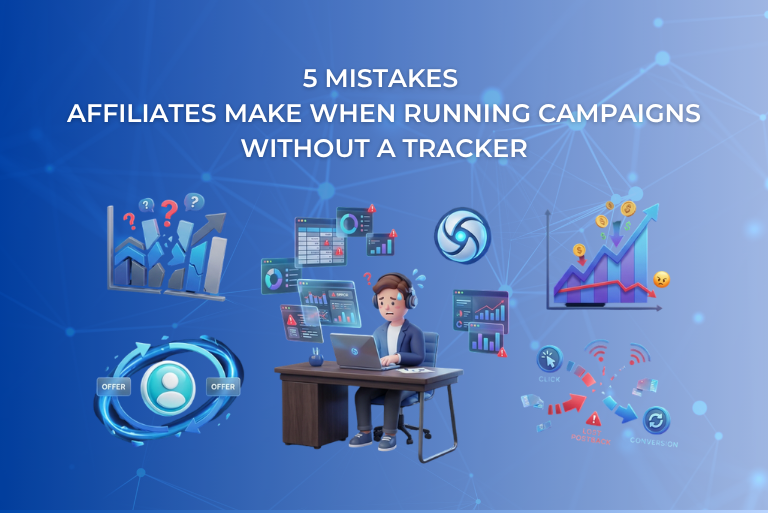
Running ad campaigns without a tracker today means knowingly losing data, wasting budget, and limiting your ability to scale.
Yet many affiliates and teams still rely on a simplified workflow:
Traffic Source → Offer → Result
This setup may work in the beginning. But once you start dealing with higher volumes, multiple traffic sources, GEOs, or offers, the cracks begin to show.
Let’s look at five common mistakes affiliates make when operating without a tracker and why they become major obstacles to scaling.
1. Optimizing based on gut feeling instead of data

Without a centralized system for collecting data, decisions are often based on incomplete or conflicting information.
Your traffic source reports one set of numbers, while your affiliate network shows another. It’s unclear where the discrepancy comes from. It’s also difficult to determine which creative is actually driving conversions and which one is simply generating clicks.
As a result, budgets are reallocated too late, and profitable campaigns may even be paused simply because their performance isn’t visible.
A tracker removes this uncertainty. Every click and every conversion is properly attributed, data stays consistent across systems, and optimization decisions are based on facts rather than assumptions.
2. Losing control over the user journey across offers

This is probably one of the least obvious but most expensive problems.
Without a tracker, you have no reliable way to control where an individual user is sent especially if they return later or interact with multiple touchpoints before converting.
The same user may be shown the exact same offer they already failed to convert on. That doesn’t just waste money on repeat exposure, it also misses the opportunity to test a different offer that might have converted instead.
A tracker lets you build routing logic. For example, if a user has already seen Offer A, you can automatically redirect them to Offer B. This becomes especially valuable when rotating multiple offers within the same GEO, where the traffic source remains the same but several offers compete for conversions.
Without that level of control, you simply don’t know who saw what or why they didn’t convert.
3. Inability to scale effectively

When campaign volume is small, skipping a tracker may feel like saving time and effort.
But the moment you try to scale, problems quickly emerge. You increase your budget, costs go up, yet revenue fails to keep pace or grows much more slowly than expected.
The reason is simple: you don’t know exactly what should be scaled.
Is the entire campaign profitable, or only traffic from a specific source, landing page, or time of day? Without a tracker, you can’t answer those questions, so scaling often becomes nothing more than increasing spend across the board with unpredictable results.
A tracker provides structure, allowing you to scale proven winning combinations instead of blindly expanding all traffic.
4. Losing conversions and event data

Without a tracker, your control over postbacks is limited.
Common issues include:
- Some conversions never make it back to the traffic source.
- Data gets lost during redirects.
- Clicks cannot be properly matched to conversions.
Every missing conversion distorts your analytics and makes optimization less accurate.
A tracker acts as the bridge between traffic sources, landing pages, and affiliate networks, ensuring that events are passed correctly and tracked consistently.
5. Data is scattered across multiple platforms

Clicks are in your traffic source.
Conversions are in your affiliate network.
Costs are in your advertising platform.
To calculate ROI for a single campaign, you often have to manually combine reports from three different systems. It’s slow, inconvenient, and leaves plenty of room for mistakes.
As your operation grows, this becomes a serious bottleneck. By the time you finish analyzing the numbers, market conditions may have already changed. Fast decision-making becomes impossible, automation is limited, and your team spends more time building spreadsheets than optimizing campaigns.
A tracker brings everything together in one interface. Costs, clicks, conversions, ROI, and every other key metric are available in one place and can be analyzed using any parameter you need.
Case study: how a tracker helped organize data and enable scaling
An affiliate team was running campaigns across multiple GEOs using a single traffic source.
Country-level distribution was handled by the traffic source itself, but within each GEO, traffic was split across several offers.
Challenges before using a tracker
- Data from the traffic source and affiliate network didn’t match.
- Some users were repeatedly sent to multiple offers.
- It was difficult to identify which campaign combinations were actually profitable.
- Scaling increased costs without delivering proportional revenue growth.
Optimization was time-consuming and often based on incomplete information.
What changed after connecting AdsBridge

The team integrated a tracker and rebuilt their flow:
Traffic Source → AdsBridge → Offers → Conversions
The traffic source continued handling traffic delivery and basic targeting, while the tracker took over:
- Flexible traffic routing within each GEO.
- Distribution between offers based on custom rules.
- User uniqueness control to prevent unnecessary duplication.
- Reliable postback management.
- Centralized collection of all campaign data in a single interface.
The results
After implementing the tracker, the team achieved:
- Consistent data across all systems.
- Clear analytics for specific campaign combinations instead of only GEO-level reporting.
- Reduced losses from duplicate user traffic.
- The ability to scale only campaigns that were already proven to be profitable.
The tracker effectively became the central control hub for their entire advertising operation.
Final thoughts
A tracker isn’t about making your workflow more complicated.
It’s about avoiding blind decisions when the cost of mistakes becomes significant.
You can certainly launch campaigns without one in the early stages. But if your goal is sustainable growth not constantly putting out fires a tracker stops being an optional tool and becomes the foundation of your entire marketing system.
If you haven’t tried AdsBridge yet, now is a great time to do so. Sign up and test the platform for free to see what your analytics look like when all your campaign data is finally consolidated in one place – START TODAY!